Showing posts with label morality. Show all posts

Thursday, May 19, 2016

Day 278: Black Earth


Nothing can be known about the future, thought Hitler, except the limits of our planet: “the surface area of a precisely measured space.” Ecology was scarcity, and existence meant a struggle for land. The immutable structure of life was the division of animals into species, condemned to “inner seclusion” and an endless fight to the death. Human races, Hitler was convinced, were like species. The highest races were still evolving from the lower, which meant that interbreeding was possible but sinful. Races should behave like species, like mating with like and seeking to kill unlike. This for Hitler was a law, the law of racial struggle, as certain as the law of gravity. The struggle could never end, and it had no certain outcome. A race could triumph and flourish and could also be starved and extinguished.

In Hitler’s world, the law of the jungle was the only law. People were to suppress any inclination to be merciful and be as rapacious as they could. Hitler thus broke with the traditions of political thought that presented human beings as distinct from nature in their capacity to imagine and create new forms of association. Beginning from that assumption, political thinkers tried to describe not only the possible but the most just forms of society. For Hitler, however, nature was the singular, brutal, and overwhelming truth, and the whole history of attempting to think otherwise was an illusion. Carl Schmitt, a leading Nazi legal theorist, explained that politics arose not from history or concepts but from our sense of enmity. Our racial enemies were chosen by nature, and our task was to struggle and kill and die.

“Nature knows,” wrote Hitler, “no political boundaries. She places life forms on this globe and then sets them free in a play for power.” Since politics was nature, and nature was struggle, no political thought was possible. This conclusion was an extreme articulation of the nineteenth-century commonplace that human activities could be understood as biology. In the 1880s and 1890s, serious thinkers and popularizers influenced by Charles Darwin’s idea of natural selection proposed that the ancient questions of political thought had been resolved by this breakthrough in zoology. When Hitler was young, an interpretation of Darwin in which competition was identified as a social good influenced all major forms of politics. For Herbert Spencer, the British defender of capitalism, a market was like an ecosphere where the strongest and best survived. The utility brought by unhindered competition justified its immediate evils. The opponents of capitalism, the socialists of the Second International, also embraced biological analogies. They came to see the class struggle as “scientific,” and man as one animal among many, instead of a specially creative being with a specifically human essence. Karl Kautsky, the leading Marxist theorist of the day, insisted pedantically that people were animals.

Yet these liberals and socialists were constrained, whether they realized it or not, by attachments to custom and institution; mental habits that grew from social experience hindered them from reaching the most radical of conclusions. They were ethically committed to goods such as economic growth or social justice, and found it appealing or convenient to imagine that natural competition would deliver these goods. Hitler entitled his book Mein Kampf—My Struggle. From those two words through two long volumes and two decades of political life, he was endlessly narcissistic, pitilessly consistent, and exuberantly nihilistic where others were not. The ceaseless strife of races was not an element of life, but its essence. To say so was not to build a theory but to observe the universe as it was. Struggle was life, not a means to some other end. It was not justified by the prosperity (capitalism) or justice (socialism) that it supposedly brought. Hitler’s point was not at all that the desirable end justified the bloody means. There was no end, only meanness. Race was real, whereas individuals and classes were fleeting and erroneous constructions. Struggle was not a metaphor or an analogy, but a tangible and total truth. The weak were to be dominated by the strong, since “the world is not there for the cowardly peoples.” And that was all that there was to be known and believed.

Hitler’s worldview dismissed religious and secular traditions, and yet relied upon both. Though he was no original thinker, he supplied a certain resolution to a crisis of both thought and faith. Like many before him he sought to bring the two together. What he meant to engineer, however, was not an elevating synthesis that would rescue both soul and mind but a seductive collision that destroyed both. Hitler’s racial struggle was supposedly sanctioned by science, but he called its object “daily bread.” With these words, he was summoning one of the best-known Christian texts, while profoundly altering its meaning. “Give us this day,” ask those who recite the Lord’s Prayer, “our daily bread.” In the universe the prayer describes, there is a metaphysics, an order beyond this planet, notions of good that proceed from one sphere to another. Those saying the Lord’s Prayer ask that God “forgive us our debts, as we also have forgiven our debtors. And lead us not into temptation, but deliver us from evil.” In Hitler’s “struggle for the riches of nature,” it was a sin not to seize everything possible, and a crime to allow others to survive. Mercy violated the order of things because it allowed the weak to propagate. Rejecting the biblical commandments, said Hitler, was what human beings must do. “If I can accept a divine commandment,” he wrote, “it’s this one: ‘Thou shalt preserve the species.’ ”

~~Black Earth: The Holocaust as History and Warning -by- Timothy Snyder

Wednesday, October 7, 2015

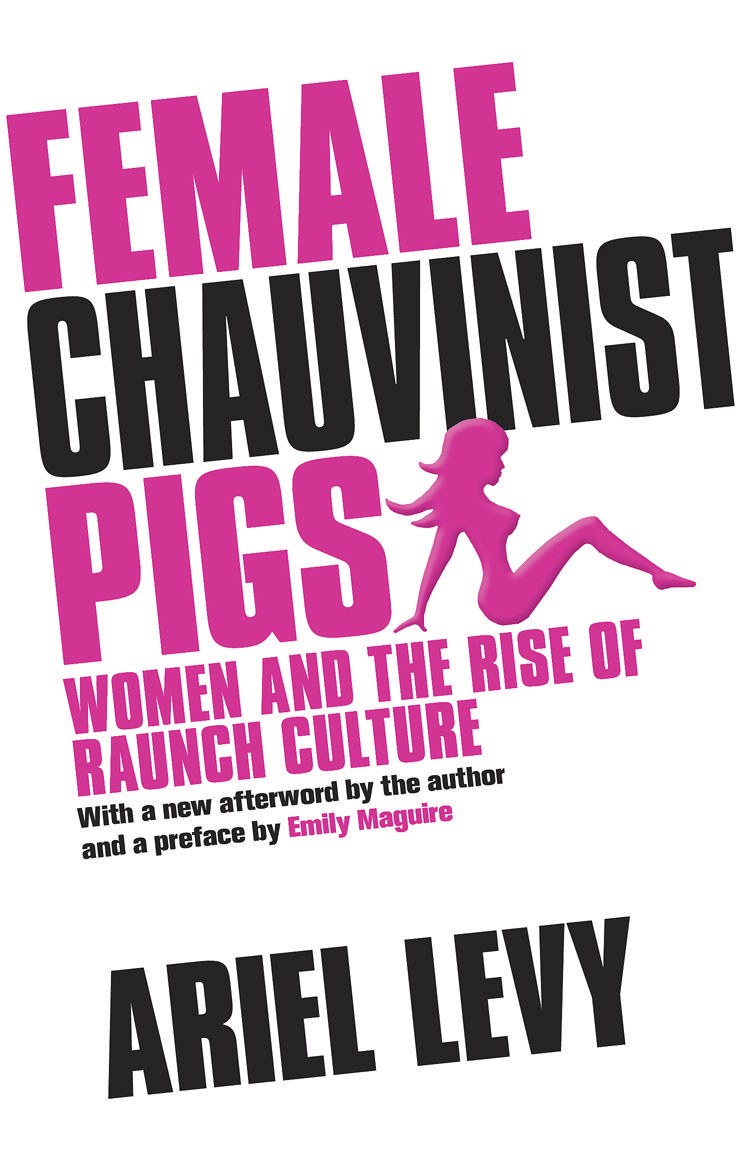
Day 54 : Book Excerpt : Female Chauvinist Pigs

Charlie’s Angels, the film remake of the quintessential jiggle show, opened at number one in 2000 and made $125 million in theaters nationally, reinvigorating the interest of men and women alike in leggy crime fighting. Its stars, who kept talking about “strong women” and “empowerment,” were dressed in alternating soft-porn styles—as massage parlor geishas, dominatrixes, yodeling Heidis in alpine bustiers. (The summer sequel in 2003—in which the Angels’ perilous mission required them to perform stripteases—pulled in another $100 million domestically.) In my own industry, magazines, a porny new genre called the Lad Mag, which included titles like Maxim, FHM, and Stuff, was hitting the stands and becoming a huge success by delivering what Playboy had only occasionally managed to capture: greased celebrities in little scraps of fabric humping the floor.

This didn’t end when I switched off the radio or the television or closed the magazines. I’d walk down the street and see teens and young women—and the occasional wild fifty-year-old—wearing jeans cut so low they exposed what came to be known as butt cleavage paired with miniature tops that showed off breast implants and pierced navels alike. Sometimes, in case the overall message of the outfit was too subtle, the shirts would be emblazoned with the Playboy bunny or say PORN STAR across the chest.

Some odd things were happening in my social life, too. People I knew (female people) liked going to strip clubs (female strippers). It was sexy and fun, they explained; it was liberating and rebellious. My best friend from college, who used to go to Take Back the Night marches on campus, had become captivated by porn stars. She would point them out to me in music videos and watch their (topless) interviews on Howard Stern. As for me, I wasn’t going to strip clubs or buying Hustler T-shirts, but I was starting to show signs of impact all the same. It had only been a few years since I’d graduated from Wesleyan University, a place where you could pretty much get expelled for saying “girl” instead of “woman,” but somewhere along the line I’d started saying “chick.” And, like most chicks I knew, I’d taken to wearing thongs.

What was going on?
...
What was almost more surprising than the change itself were the responses I got when I started interviewing the men and—often—women who edit magazines like Maxim and make programs like The Man Show and Girls Gone Wild. This new raunch culture didn’t mark the death of feminism, they told me; it was evidence that the feminist project had already been achieved. We’d earned the right to look at Playboy; we were empowered enough to get Brazilian bikini waxes. Women had come so far, I learned, we no longer needed to worry about objectification or misogyny. Instead, it was time for us to join the frat party of pop culture, where men had been enjoying themselves all along. If Male Chauvinist Pigs were men who regarded women as pieces of meat, we would outdo them and be Female Chauvinist Pigs: women who make sex objects of other women and of ourselves.

When I asked female viewers and readers what they got out of raunch culture, I heard similar things about empowering miniskirts and feminist strippers, and so on, but I also heard something else. They wanted to be “one of the guys”; they hoped to be experienced “like a man.” Going to strip clubs or talking about porn stars was a way of showing themselves and the men around them that they weren’t “prissy little women” or “girly-girls.” Besides, they told me, it was all in fun, all tongue-in-cheek, and for me to regard this bacchanal as problematic would be old-school and uncool.

I tried to get with the program, but I could never make the argument add up in my head. How is resurrecting every stereotype of female sexuality that feminism endeavored to banish good for women? Why is laboring to look like Pamela Anderson empowering? And how is imitating a stripper or a porn star—a woman whose job is to imitate arousal in the first place—going to render us sexually liberated?

Despite the rising power of Evangelical Christianity and the political right in the United States, this trend has only grown more extreme and more pervasive in the years that have passed since I first became aware of it. A tawdry, tarty, cartoonlike version of female sexuality has become so ubiquitous, it no longer seems particular. What we once regarded as a kind of sexual expression we now view as sexuality. As former adult film star Traci Lords put it to a reporter a few days before her memoir hit the best-seller list in 2003, “When I was in porn, it was like a back-alley thing. Now it’s everywhere.” Spectacles of naked ladies have moved from seedy side streets to center stage, where everyone—men and women—can watch them in broad daylight. Playboy and its ilk are being “embraced by young women in a curious way in a postfeminist world,” to borrow the words of Hugh Hefner.

But just because we are post doesn’t automatically mean we are feminists. There is a widespread assumption that simply because my generation of women has the good fortune to live in a world touched by the feminist movement, that means everything we do is magically imbued with its agenda. It doesn’t work that way. “Raunchy” and “liberated” are not synonyms. It is worth asking ourselves if this bawdy world of boobs and gams we have resurrected reflects how far we’ve come, or how far we have left to go.

~~Female Chauvinist Pigs: Women and The Rise of Raunch Culture -by- Ariel Levy

Friday, September 18, 2015

Day 35: Book Excerpt: The Bonobo and the Atheist

Animals crawling out of the mud recall our lowly beginnings. Everything started simple. This holds not only for our bodies—with hands derived from frontal fins and lungs from a swim bladder—but equally for our mind and behavior. The belief that morality somehow escapes this humble origin has been drilled into us by religion and embraced by philosophy. It is sharply at odds, however, with what modern science tells us about the primacy of intuitions and emotions. It is also at odds with what we know about other animals. Some say that animals are what they are, whereas our own species follows ideals, but this is easily proven wrong. Not because we don’t have ideals, but because other species have them, too.

Why does a spider repair her web? It’s because she has an ideal structure in mind, and as soon as her web deviates from it, she works hard to bring it back to its original shape. How does a “Mama Grizzly” keep her young safe? Anybody moving between a sow and her cubs will discover that she has an ideal configuration in mind, which she doesn’t like to be messed with. The animal world is full of repair and correction, from disturbed beaver dams and anthills to territorial defense and rank maintenance. Failing to obey the hierarchy, a subordinate monkey upsets the accepted order, and all hell breaks loose. Corrections are by definition normative: they reflect how animals feel things ought to be. Most pertinent for morality, which is also normative, social mammals strive for harmonious relationships. They are at pains to avoid conflict whenever they can. The gladiatorial view of nature is plainly wrong. In one field experiment, two fully grown male baboons refused to touch a peanut thrown between them, even though they both saw it land at their feet. Hans Kummer, the Swiss primatologist who worked all his life with wild hamadryas baboons, describes how two harem leaders, finding themselves in a fruit tree too small to feed both of their families, broke off their inevitable confrontation by literally running away from each other. They were followed by their respective females and offspring, leaving the fruit unpicked. Given the huge, slashing canine teeth of a baboon, few resources are worth a fight. Chimp males face the same dilemma. From my office window, I often see several of them hang around a female with swollen genitals. Rather than competing, these males are trying to keep the peace. Frequently glancing at the female, they spend their day grooming each other. Only when everyone is sufficiently relaxed will one of them try to mate.

If fighting does break out, primates react the way the spider does to a torn web: they go into repair mode. Reconciliation is driven by the importance of social relationships. Studies on a great variety of species show that the closer two individuals are, and the more they do together, the more likely they are to make up after aggression. Their behavior reflects awareness of the value of friendships and family bonds. This often requires them to overcome fear or suppress aggression. If it weren’t for the need to bury the hatchet, it wouldn’t make any sense for apes to kiss and embrace former opponents. The smart thing to do would be to stay away from them.
This brings me back to my bottom-up view of morality. The moral law is not imposed from above or derived from well-reasoned principles; rather, it arises from ingrained values that have been there since the beginning of time. The most fundamental one derives from the survival value of group life. The desire to belong, to get along, to love and be loved, prompts us to do everything in our power to stay on good terms with those on whom we depend. Other social primates share this value and rely on the same filter between emotion and action to reach a mutually agreeable modus vivendi. We see this filter at work when chimpanzee males suppress a brawl over a female, or when baboon males act as if they failed to notice a peanut. It all comes down to inhibitions.
...
We are mammals, a group of animals marked by sensitivity to each other’s emotions. Even though I tend to favor primate examples, much of what I describe applies equally to other mammals. Take the work by the American zoologist Marc Bekoff, who analyzed videos of playing dogs, wolves, and coyotes. He concluded that canid play is subject to rules, builds trust, requires consideration of the other, and teaches the young how to behave. The highly stereotypical “play bow” (an animal crouches deep on her forelimbs while lifting her rear in the air) helps to set play apart from sex or conflict, with which it risks getting confused. Play ceases abruptly, though, as soon as one partner misbehaves or accidentally hurts the other. The transgressor “apologizes” by performing a new play bow, which may prompt the other to “forgive” the offense and continue to play. Role reversals make play even more exciting, such as when a dominant pack member rolls onto his back for a puppy, thus exposing his belly in an act of submission. This way, he lets the little one “win,” something he’d never permit in real life. Bekoff, too, sees a relation with morality:

    During social play, while individuals are having fun in a relatively safe environment, they learn ground rules that are acceptable to others—how hard they can bite, how roughly they can interact—and how to resolve conflicts. There is a premium on playing fairly and trusting others to do so as well. There are codes of social conduct that regulate what is permissible and what is not permissible, and the existence of these codes might have something to say about the evolution of morality.

~~The Bonobo and The Atheist -by- Frans De Waal