Showing posts with label quantum physics. Show all posts

Saturday, June 25, 2016

Day 315: Einstein’s Dice and Schrödinger’s Cat


This is the tale of two brilliant physicists, the 1947 media war that tore apart their decades-long friendship, and the fragile nature of scientific collaboration and discovery.

When they were pitted against each other, each scientist was a Nobel laureate, well into middle age, and certainly past the peak of his major work. Yet the international press largely had a different story to tell. It was a familiar narrative of a seasoned fighter still going strong versus an upstart contender hungry to seize the trophy. While Albert Einstein was extraordinarily famous, his every pronouncement covered by the media, relatively few readers were conversant with the work of Austrian physicist Erwin Schrödinger.

Those following Einstein’s career knew that he been working for decades on a unified field theory. He hoped to extend the work of nineteenth-century British physicist James Clerk Maxwell in uniting the forces of nature through a simple set of equations. Maxwell had provided a unified explanation for electricity and magnetism, called electromagnetic fields, and identified them as light waves. Einstein’s own general theory of relativity described gravity as a warping of the geometry of space and time. Confirmation of the theory had won him fame. However, he didn’t want to stop there. His dream was to incorporate Maxwell’s results into an extended form of general relativity and thereby unite electromagnetism with gravity.

Every few years, Einstein had announced a unified theory to great fanfare, only to have it quietly fail and be replaced by another. Starting in the late 1920s, one of his primary goals was a deterministic alternative to probabilistic quantum theory, as developed by Niels Bohr, Werner Heisenberg, Max Born, and others. Although he realized that quantum theory was experimentally successful, he judged it incomplete. In his heart he felt that “God did not play dice,” as he put it, couching the issue in terms of what an ideal mechanistic creation would be like. By “God” he meant the deity described by seventeenth-century Dutch philosopher Baruch Spinoza: an emblem of the best possible natural order. Spinoza had argued that God, synonymous with nature, was immutable and eternal, leaving no room for chance. Agreeing with Spinoza, Einstein sought the invariant rules governing nature’s mechanisms. He was absolutely determined to prove that the world was absolutely determined.

Exiled in Ireland in the 1940s after the Nazi annexation of Austria, Schrödinger shared Einstein’s disdain for the orthodox interpretation of quantum mechanics and saw him as a natural collaborator. Einstein similarly found in Schrödinger a kindred spirit. After sharing ideas for unification of the forces, Schrödinger suddenly announced success, generating a storm of attention and opening a rift between the men.

You may have heard of Schrödinger’s cat—the feline thought experiment for which the general public knows him best. But back when this feud took place, few people outside of the physics community had heard of the cat conundrum or of him. As depicted in the press, he was just an ambitious scientist residing in Dublin who might have landed a knockout punch on the great one.
The leading announcer was the Irish Press, from which the international community learned about Schrödinger’s challenge. Schrödinger had sent them an extensive press release describing his new “theory of everything,” immodestly placing his own work in the context of the achievements of the Greek sage Democritus (the coiner of the term “atom”), the Roman poet Lucretius, the French philosopher Descartes, Spinoza, and Einstein himself. “It is not a very becoming thing for a scientist to advertise his own discoveries,” Schrödinger told them. “But since the Press wishes it, I submit to them.”

The New York Times cast the announcement as a battle between a maverick’s mysterious methods and the establishment’s lack of progress. “How Schrödinger has proceeded we are not told,” it reported.

For a fleeting moment it seemed that a Viennese physicist whose name was then little known to the general public had beaten the great Einstein to a theory that explained everything in the universe. Perhaps it was time, puzzled readers may have thought, to get to know Schrödinger better.

Today, what comes to mind for most people who have heard of Schrödinger are a cat, a box, and a paradox. His famous thought experiment, published as part of a 1935 paper, “The Present Situation in Quantum Mechanics,” is one of the most gruesome devised in the history of science. Hearing about it for the first time is bound to trigger gasps of horror, followed by relief that it is just a hypothetical experiment that presumably has never been attempted on an actual feline subject.

Schrödinger proposed the thought experiment in 1935 as part of a paper that investigated the ramifications of entanglement in quantum physics. Entanglement (the term was coined by Schrödinger) is when the condition of two or more particles is represented by a single quantum state, such that if something happens to one particle the others are instantly affected.

Inspired in part by dialogue with Einstein, the conundrum of Schrödinger’s cat presses the implications of quantum physics to their very limits by asking us to imagine the fate of a cat becoming entangled with the state of a particle. The cat is placed in a box that contains a radioactive substance, a Geiger counter, and a sealed vial of poison. The box is closed, and a timer is set to precisely the interval at which the substance would have a 50–50 chance of decaying by releasing a particle. The researcher has rigged the apparatus so that if the Geiger counter registers the click of a single decay particle, the vial would be smashed, the poison released, and the cat dispatched. However, if no decay occurs, the cat would be spared.

According to quantum measurement theory, as Schrödinger pointed out, the state of the cat (dead or alive) would be entangled with the state of the Geiger counter’s reading (decay or no decay) until the box is opened. Therefore, the cat would be in a zombielike quantum superposition of deceased and living until the timer went off, the researcher opened the box, and the quantum state of the cat and counter “collapsed” (distilled itself) into one of the two possibilities.

~~Einstein’s Dice and Schrödinger’s Cat: How Two Great Minds Battled Quantum Randomness to Create a Unified Theory of Physics -by- Paul Halpern

Friday, June 24, 2016

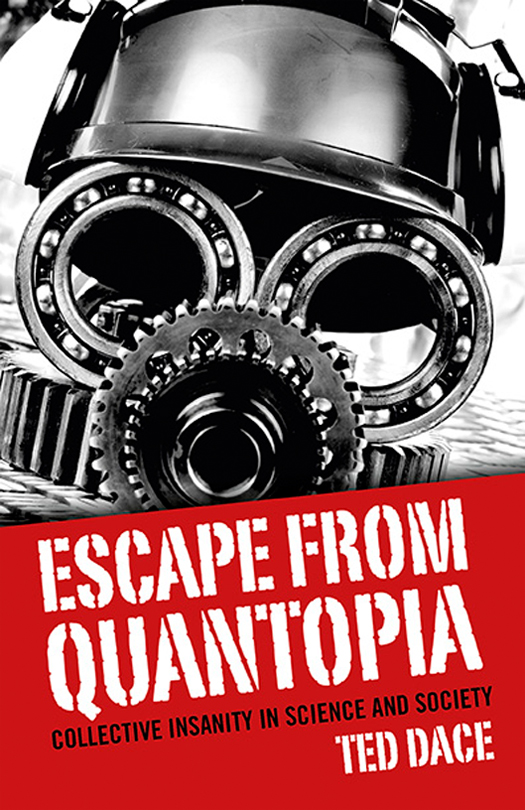
Day 314: Escape From Quantopia


Giordano Bruno discovered in the lights of the night sky a bottomless ocean of suns where others saw only sketches projected from human imagination. Alone among the pioneers of science, Bruno fully absorbed the lesson of Copernicus, something even the solar revolutionary himself failed to grasp. Not only is the cosmos not centered on Earth but the very idea of center has no physical meaning. There’s no more a privileged location from which all places are subject to objective measurement than a virgin or a goatfish in the sky.

“For there is in the Universe,” wrote the itinerant philosopher, “neither center nor circumference, but, if you will, the whole is central, and every point also may be regarded as part of a circumference in respect to some other central point.” If Earth seems like the center of all things, that’s only because we live on it. To lunar dwellers the Moon is center-stage. It’s all perspective.

Bruno never hesitated to announce his relativistic revelation to any and all. For this and other “impieties,” the church ordered him burned at the stake on Ash Wednesday 1600.

His successors lacked his penetrating insight. Following Isaac Newton’s observation that massive bodies attract each other at a distance, consensus opinion coalesced around the idea of a subtle kind of matter permeating space that mediates the force of gravity much as water mediates waves on the ocean. In the nineteenth century scientists updated this approach with their contention that electromagnetic waves propagate across a “luminiferous aether.” Aside from serving as a fixed framework establishing the boundaries and absolute center of the universe, the aether was thought to enable the cosmic machine to operate by contact mechanics, not unlike the contraptions we fashion down here on the terrestrial plane.

By the turn of the twentieth century, the great questions of existence seemed to be dissolving in the magic potion of science. The world had never been so clear, the ground never so solid and dependable.
Since then all center and substance have shattered. Bruno could at least count on God. Now we’ve got nothing, adrift in a void without reference points. The Great Wall of Certainty has collapsed under its own density. From the other side Bruno confronts us with crackling skin and blazing eye.

Up until 1897 the idea of material substance wasn’t generally regarded as a pre-scientific mirage. But in that year JJ Thomson cut the “uncuttable” atom. The solid core of matter turned out to be internally differentiated, with vast empty gulfs punctuated by occasional pinpricks of mass. An electron isn’t so much a thing as a field of possibilities across which a “particle” randomly bops around like a speck of static on a TV screen. It’s a dance whose steps can be calculated according to a probability wave. Let’s say an electron is trapped inside a perfectly sealed container. As it bounces off the walls, its probability wave gradually seeps out to the surrounding area until the electron itself is no longer inside the container.

This is why quantum physicists don’t speak of substance. Reality is composed of “information.” The randomness of the quantum level averages out to the predictability of the perceptual level. All that is solid melts into stats.

The de-centering of all centers began in 1887 when Albert Michelson and Edward Morley carried out an experiment designed to prove the existence of the aether. Their “interferometer,” a box containing a telescope and mirrors set at odd angles, could measure the speed of light on Earth relative to its speed in outer space. Since our planet is in motion, scientists reasoned that the light reaching us from a distant source should be either faster or slower than in the stillness of space, depending on whether we’re approaching the starlight or receding. But when Michelson and Morley looked at their results, they found no interference and therefore no difference in the speed of light relative to Earth’s motion.
For years their findings puzzled physicists, though Hendrick Lorentz wrote up some interesting equations meant to explain how the aether was somehow still relevant despite the no-show in ‘87. Not until Einstein came along did anyone see the true weight of the Michelson-Morley results. With a little tweaking of Lorentz’s equations, he demonstrated that space has no fixed framework, no center or circumference. As far as the universe is concerned, we are nowhere. Bruno was vindicated.

Whether you’re adrift in deep space or breezing along at 185,000 miles per second, light always travels faster, at 186,000 miles per second. light always travels 186,000 miles per second faster. Change your frame of reference and the flow of time changes along with it. Only the speed of light remains constant.

Or so we thought. Light has many different speeds, depending on what kind of medium it’s traversing. Water, for instance, slows it down by 75%. In the final days of the twentieth century, researcher Lene Vestergaard Hau imprisoned a beam of light in a frozen cloud of atoms, stopping it dead in its tracks and demonstrating, once and for all, that nothing is sacred.
...
You don’t have to consult Aristotle to realize something is holding all this up. You can’t have miles and miles of accident and no essence anywhere in sight. Something’s got to be substantial, not just informational. Absolute, not just relative. Even illusion is illusory only in contrast to reality. Who or what is hallucinating this hallucination?
For the answer we must go back, once more, to that magnetic moment when the world turned inside out. The clock is winding down on the nineteenth century as young Henri Bergson, a Polish Jew transplanted to France, studies philosophy at the Ecole Superier Normale. Captivated by the English positivist Herbert Spencer and his book, Progress: Its Law and Cause, Bergson is dazzled by the promise of a completely coordinated system of knowledge, a synthetic scheme founded on a single absolute principle: the persistence of force. Physical science, prophecies Spencer, shall render the world transparent, granting unimagined power to the human race.

Then one day Bergson is shaken by a terrible insight, as if the whole twentieth-century intellectual meltdown has appeared to him in a blast.

There’s no time in physics.

“Newton’s laws of motion,” according to physicists Christopher Hill and Leon Lederman, “make no distinction between past and future, and time can apparently flow in any direction.” On their website devoted to mathematician Emmy Noether and her principle of symmetry-breaking, Hill and Lederman describe the universe as a movie that could run through a projector in reverse as readily as forward. “When applied to simple systems, billiard balls colliding on the table, atomic collisions, etc., it would not be possible to tell in which direction the film was progressing. The motion we see satisfies laws of motion that are the same, whether run forward or backward.”5 Future and past are effectively interchangeable.

“Notice another peculiar aspect of physics,” write Hill and Lederman. “Nowhere in any formulation does the issue of a special point in time called ‘now’ ever occur. Yet, we humans sense something we call ‘now.’ Is it an illusion? We call this the ‘Now’ question.”

I can’t help but feel present. Even memories concern moments once present. To be human is to be temporal, informed by a past and oriented toward a future. Without ongoing presence our consciousness, the sensation of now, is null and void. Lacking real time, we aren’t real either.

~~Escape From Quantopia: Collective Insanity in Science and Society -by- Ted Dace