Showing posts with label literature. Show all posts

Monday, June 27, 2016

Day 317: Thinking With Whitehead


He glanced at me, suspicious. "You're not paying attention."

"I am!" I said, joining my hands to show my seriousness.

But he shook his head slowly. "Nothing interests you but excitement, violence."

"That's not true!" I said.

His eye opened wider, his body brightened from end to end. "You tell me what's true?" he said.

"I'm trying to follow you. I do my best," I said. "You should be reasonable. What do you expect?"

The dragon thought about it, breathing slowly, full of wrath. At last he closed his eyes: "Let us try starting somewhere else," he said. "It's damned hard, you understand, confining myself to concepts familiar to a creature of the Dark Ages. Not that one age is darker than another. Technical jargon from another dark age." He scowled as if hardly capable of forcing himself on. Then, after a long moment: "The essence of life is to be found in the frustrations of established order. The universe refuses the deadening influence of complete conformity. And yet in its refusal, it passes toward novel order as a primary requisite for important experience. We have to explain the aim at forms of order, and the aim at novelty of order, and the measure of success, and the measure of failure. Apart from some understanding, however dim-witted, of these characteristics of historic process..." His voice trailed off.

How does a dragon talk? Such is the problem John Gardner had to solve when he undertook to reinvent the epic poem Beowulf, a poem that, as every English-speaking student has learned, is the oldest European literary work written in a vernacular tongue to have come down to us. In the original work, slow and somber, Beowulf is the hero who fights against the forces of evil : the monster Grendel, whom he kills in the first part of the poem, and the dragon whom he will likewise kill in the second part, but who will mortally wound him. In Gardner's fiction, however, it is Grendel who tells his story, for the question of knowing how one gets to be a monster produces a more interesting viewpoint than the one defined by the good. One thus discovers that if Grendel kills men, it is because he is simultaneously the witness, judge, and impotent voyeur of the strange power fiction has over them, and confers upon them. He has seen them build themselves a destiny, a heroic past, a glorious future, with the words invented for them by the Shaper, or the Poet i n the strong sense of giver of form. Grendel is aware of the lies in these words, but this knowledge excludes him from what is taking shape before his eyes: his lucidity brings him nothing but hatred and despair. Thus, he chooses, forever solitary, to be the Great Destroyer for human beings, or more precisely the Great Deconstructor. He will derive a bitter, monotonous pleasure from the proof he never ceases inflicting on humans of the impotence of their Gods, the senseless character of their lives, and the vanity of their heroes.

Hatred is a choice, not a consequence.  Before becoming the scourge of humankind, Grendel met a being much older than himself, the dragon that Beowulf was to fight one day. This dragon is "beyond good and evil," beyond both the passion for constructing and for destroying illusory constructions. For him, nihilistic rage is just as absurd as belief, for everything is tied together, everything goes hand in hand, creation and destruction, lies and authenticity. And he knows that Grendel will choose excitement and violence, despite his advice, the only one he can give: seek out gold and sit on it...

The homage of fiction to philosophy. It is fairly easy to give voice to a denouncer, an idol-smasher, a denier of all belief. Yet it is much harder to give voice to a nonhuman knowledge, more ancient than humankind, able to see farther than the insignificant ripple they create in the river of time. To escape the human point of view, and to do so with the calm self-evidence that is appropriate, as if the workings of the universe belonged to what is given, beyond all conquest and hypothesis, Gardner turned to the philosopher Alfred North Whitehead, copying out entire passages from Whitehead's last book, Modes of Thought.

In what follows, Grendel was to encounter Whitehead a second time. It happened in the course of an incursion that took him toward the circle of the Gods, those statues that terrorized men ask in vain for protection against him. Grendel meets the blind Ork, the eldest and wisest of the priests. He decides to have some fun and, before killing Ork, he asks him to confess his faith, and say who is the King of the Gods. This time, in breathless succession, it is the God of Science and the Modern World, the principle of limitation, ultimate irrationality, then that of Process of Reality, with his infinite patience, his tender concern that nothing may be lost, that come from the blind man's lips. Grendel, bewildered, lets his prey get away.

The words of a dragon, surging forth from the depths of the ages, associated with the neutrality of one for whom epochs, importances, and arrogances succeed one another, but also words of trance, come from nowhere, able to rout Grendel, who has declared war on the poet's tale-spinning: the reader has now been warned. It is a strange tongue that will gradually be elaborated here, a language that challenges all clear distinctions between description a nd tale-spinning, and induces a singular experience of disorientation in the heart of the most familiar experiences. It is a language that can scandalize, or else madden, all those who think they know what they know, but also all those for whom to approach the non-knowing at the heart of all knowledge is an undertaking that is meticulous, grave, and always to be taken up again.

~~Thinking With Whitehead: A Free and Wild Creation of Concepts -by- Isabelle Stengers

Saturday, June 11, 2016

Day 301: A Short History Of Myth


In about 4000 BCE, human beings took another major step forward when they began to build cities, first in Mesopotamia and Egypt in about 4000 BCE, and later in China, India and Crete. Some of these early civilisations disappeared almost without trace, but in the Fertile Crescent, in what is now Iraq, we see an early response to the challenge of urbanisation in the mythology that celebrated city life. Human life was becoming more self-conscious. People could now give permanent expression to their aspirations in the civilised arts, and the invention of writing meant that they could give enduring literary expression to their mythology. They had now entered the historical age: in the cities, the rate of change accelerated, and people became more aware of the chain of cause and effect. The new technology gave city-dwellers a more complete control over their environment, and they were becoming increasingly more distinct from the natural world. It was a time of excitement, liberation and pride.

But major change on this scale also inspires great fear. It has been said that history is a process of annihilation, since each new development requires the destruction of what has gone before. This was clearly the case in the Mesopotamian cities, where the mudbrick buildings needed constant maintenance and periodic reconstruction. New structures were erected on top of the levelled ruins of their predecessors, and the process of decay and renewal was thus built into the new art of town planning. Civilisation was experienced as magnificent but fragile; a city shot up and flourished dramatically, but then all too quickly went into decline. When one city-state rose to pre-eminence, it preyed upon its rivals. There were wars, massacres, revolutions and deportations. The destruction meant that the culture that had been so painfully achieved needed to be rebuilt and established again and again. There was constant fear that life would revert to the old barbarism. With mingled apprehension and hope, the new urban myths meditated on the endless struggle between order and chaos.

Not surprisingly, some saw civilisation as a disaster. The biblical writers saw it as a sign of the separation from God that had followed the expulsion from Eden. Urban life seemed inherently violent, involving killing and exploitation. The first man to build a city was Cain, the first murderer, his descendants invented the civilised arts: Jubal was ‘the ancestor of all those who play the lyre and the pipes’, and Tubal-cain ‘made all kinds of bronze and iron tools’. The great ziggurat or temple-tower of Babylon made a profound and unfavourable impression on the ancient Israelites. It seemed the epitome of pagan hubris, motivated solely by a desire for self-aggrandisement. They called it the Tower of Bavel or Babble, because, to punish the builders, God had ‘baffled the language of all the earth-folk, and from there scattered them over the face of all the earth’.

But the people of Mesopotamia themselves saw the city as a place where they could encounter the divine. It was – almost – a recreation of the lost paradise. The ziggurat replaced the mountain at the centre of the world, which had enabled the first human beings to climb up to the world of the gods. The gods lived in the cities, side by side with men and women in temples that were replicas of their palaces in the divine world. In the ancient world, every city was a holy city. As their ancestors had regarded hunting and farming as sacred and sacramental activities, these early city-dwellers saw their cultural attainments as essentially divine. In Mesopotamia, the gods had taught men how to build the ziggurats, and Enki, god of wisdom, was the patron of leather-workers, metal-smiths, barbers, builders, potters, irrigation technicians, physicians, musicians and scribes. They knew that they had embarked on a wondrous enterprise that would transform human life forever; their cities were transcendent, because they went beyond anything known before. They partook of the divine creativity of the gods, who had somehow brought order out of the confusion of chaos.

But the Israelites were wrong to imagine that the people of Mesopotamia were guilty of hubris. They knew that human life – even in their imposing cities – was flawed and transitory, in comparison with the world of the gods, which still formed the backdrop of their daily lives. Their cities were only a pale shadow of the lost paradise of Dilmun, inhabited now only by gods and a few exceptional human beings. They were acutely aware that, like human life itself, civilisation was fragile and impermanent. In Egypt, a compact country, isolated and protected from hostile forces by mountains, and fertilised by the regular flooding of the Nile, there was greater confidence in human achievement. But in Mesopotamia, where the flooding of the Tigris and Euphrates was unpredictable and often destructive, where torrential rain could turn the soil into a quagmire, or scorching winds reduce it to dust, and where there was constant threat of invasion, life was far less secure. The maintenance of civilisation seemed to require a heroic effort against the wilful and destructive powers of nature. These fears are especially evident in their flood myths. Rivers in Mesopotamia are prone to sudden shifts of direction because there are no natural obstacles, so flooding was frequent and often disastrous. A flood was not a blessing, as in Egypt, but became a metaphor for political and social dissolution.

Whenever they enter a new era of history, people change their ideas of both humanity and divinity. In these early civilisations, men and women were becoming more like us moderns, more aware than ever before that they were the masters of their own destiny. Consequently, they could no longer see the gods in the same way as their ancestors had. Because human actions were now centre-stage, the gods seemed more remote; they were no longer a reality that was self-evident and only just out of reach. The new urban mythology saw the Flood as marking a crisis in divine–human relations. In Atrahasis, the longest of the Mesopotamian Flood poems, the gods, like men, are town planners. The lesser deities go on strike, exhausted by the endless labour of digging irrigation canals to make the countryside habitable, so the Mother Goddess creates human beings to perform these menial tasks instead. But they become too numerous and so noisy that Enlil, the storm god, who is kept awake by the din, decides to inundate the world as a brutal method of population control. But Enki wants to save Atrahasis, the ‘exceedingly wise man’ of the city of Shuruppak. The two enjoy a special friendship, so Enki tells Atrahasis to build a boat, instructing him about the technology that would keep it watertight and, because of this divine intervention, Atrahasis, like Noah, is able to save his family and the seeds of all living things. But after the waters subside, the gods are horrified by the devastation. In Mesopotamian myth, the Flood marks the beginning of the gods’ withdrawal from the world. Enki takes Atrahasis and his wife to Dilmun. They would be the only humans to enjoy immortality and the old intimacy with the gods. But the story also celebrates the divinely inspired technology that had saved the human race from extinction. Increasingly in Mesopotamia, as in our own modernity, civilisation and culture would become the focus of myth and aspiration.

~~A Short History Of Myth -by- Karen Armstrong

Saturday, February 27, 2016

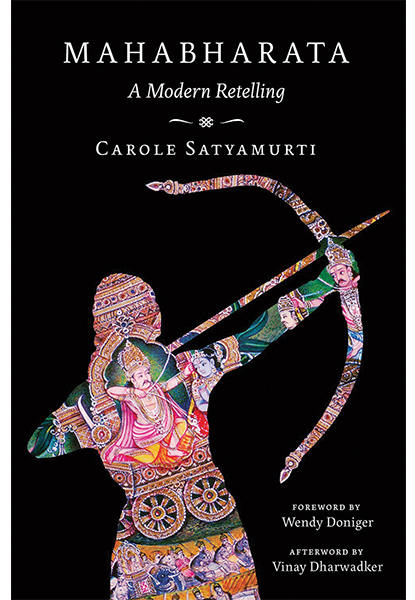
Day 194: Mahabharata: A Modern Retelling


THE Mahabharata is a text of about 75,000 verses—sometimes rounded off to 100,000—or three million words, some fifteen times the combined length of the Hebrew Bible and the New Testament, or seven times the Iliad and the Odyssey combined, and a hundred times more interesting. More interesting both because its attitude to war is more conflicted and complex than that of the Greek epics and because its attitude to divinity is more conflicted and complex than that of the Jewish and Christian scriptures. It resembles the Homeric epics in many ways (such as the theme of the great war, the style of its poetry, and its heroic characters, several of them fathered by gods), but unlike the Homeric gods, many of the Mahabharata gods were then, and still are, worshipped and revered in holy texts, including parts of the Mahabharata itself. It has remained central to Hindu culture since it was first composed. It is thus “great” (Maha), as its name claims, not only in size but in scope. Hindus from the time of the composition of the Mahabharata to the present moment know the characters in the texts just as Christians and Jews and Muslims, even if they are not religious, know Adam and Eve. To this day, India is called the land of Bharata, and the Mahabharata functions much like a national epic.

The story may have been told in some form as early as 900 BCE; its resemblance to Persian, Scandinavian, Greek, and other Indo-European epic traditions suggests that the core of the tale may reach back to the time when these cultures had not yet dispersed, well before 2000 BCE. But the Mahabharata did not reach its present form until the period from about 300 BCE to 300 CE—or half a millennium; it takes a long time to compose three million words.
The Mahabharata marks the transition from the corpus of Sanskrit texts known as shruti, the unalterable Vedic canon of texts (dated to perhaps 1500 BCE) that the seers “heard” from divine sources, to those known as smriti, the human tradition, constantly revised, the “remembered texts” of human authorship, texts that could be altered. It calls itself “the fifth Veda” (though so do several other texts) and dresses its story in Vedic trappings (such as ostentatious Vedic sacrifices). It looks back to the Vedic age, and may well preserve many memories of that period, and that place, up in the Punjab. The Painted Gray Ware artifacts discovered at sites identified with locations in the Mahabharata may be evidence of the reality of the great Mahabharata war, which is usually supposed to have occurred around 950 BCE. But the text is very much the product of its times, the centuries before and after the turn of the first millennium.

The Mahabharata was retold very differently by all of its many authors in the long line of literary descent. It is so extremely fluid that there is no single Mahabharata; there are hundreds of Mahabharatas, hundreds of different manuscripts and innumerable oral versions (one reason why it is impossible to make an accurate calculation of the number of its verses). The Mahabharata is not confined to a text; the story is there to be picked up and found, salvaged as anonymous treasure from the ocean of story. It has been called “a work in progress,” a literature that “does not belong in a book.” The Mahabharata (1.1.23) describes itself as unlimited in both time and space—eternal and infinite: “Poets have told it before, and are telling it now, and will tell it again. What is here is also found elsewhere, but what is not here is found nowhere else.” And in case you missed that, it is repeated elsewhere and then said yet again in slightly different words toward the end of the epic: “Whatever is here about dharma, profit, pleasure, and release [from the cycle of death and rebirth] is also found elsewhere, but what is not here is found nowhere else . . .” (18.5.38).

The Mahabharata grew and changed in numerous parallel traditions spread over the entire subcontinent of India, constantly retold and rewritten, both in Sanskrit and in vernacular dialects. It grows out of the oral tradition and then grows back into the oral tradition; it flickers back and forth between Sanskrit manuscripts and village storytellers, each adding new gemstones to the old mosaic, constantly reinterpreting it. The loose construction of the text gives it a quasi-novelistic quality, open to new forms as well as new ideas, inviting different ideas to contest one another, to come to blows, in the pages of the text. It seems to me highly unlikely that any single author could have lived long enough to put it all together, but that does not mean that it is a miscellaneous mess with no unified point of view, let alone “the most monstrous chaos,” “the huge and motley pile,” or “gargantuan hodge-podge” and “literary pile-up” that some scholars have accused it of being. European approaches to the Mahabharata often assumed that collators did not know what they were doing and, blindly cutting and pasting, accidentally created a monstrosity.

But the Mahabharata is not the head of a brahmin philosophy accidentally stuck onto a body of non-brahmin folklore, like the heads and bodies of people in several Indian myths, or the mythical beast invoked by Woody Allen, which has the body of a lion and the head of a lion, but not the same lion. True, it was somewhat like an ancient Wikipedia, to which anyone who knew Sanskrit, or who knew someone who knew Sanskrit, could add a bit here, a bit there. But the powerful intertextuality of Hinduism ensured that anyone who added anything to the Mahabharata was well aware of the whole textual tradition behind it and fitted his or her own insight, or story, thoughtfully into the ongoing conversation. However diverse its sources, for several thousand years the tradition has regarded it as a conversation among people who know one another’s views and argue with silent partners. It is a contested text, a brilliantly orchestrated hybrid narrative with no single party line on any subject. It was contested not only within the Hindu tradition, where concepts of dharma were much debated, but also by the rising rival traditions of Buddhism and Jainism. These challenges to the brahmin narrators are reflected in the text at such places as Bhishma’s teachings in Books 12 and 13. But the text has an integrity that the culture supports (in part by attributing it to a single author) and that it is our duty to acknowledge. The contradictions at its heart are not the mistakes of a sloppy editor but enduring cultural dilemmas that no author could ever have resolved.

The great scholar and poet A. K. Ramanujan used to say that no Indian ever hears the Mahabharata for the first time. For centuries Indians heard it in the form of public recitations, or performances of dramatized episodes, or in the explanations of scenes depicted in stone or paint on the sides of temples. More recently, they read it in India’s version of Classic Comics (the Amar Chitra Katha series) or saw it in the hugely successful televised version, based largely on the comic book; the streets of India were empty (or as empty as any street ever is in India) during the broadcast hours on Sunday mornings, from 1988 to 1990. Or they saw various Bollywood versions, or the six-hour film version (1989) of Peter Brook’s nine-hour theatrical adaptation (1985).

~~Mahabharata: A Modern Retelling -by- Carole Satyamurti

Friday, December 4, 2015

Day 110: Book Excerpt: Medieval and Early Modern Science


1. Alchemical Poetry in Late Medieval England

In the fifteenth century, on the threshold of the early modern period, England witnessed tremendous political, social and cultural change. The universities of Oxford and Cambridge operated amidst a growing number of academic institutions in the British Isles and in continental Europe—the Scottish universities of St. Andrews (1411) and Glasgow (1451) were part of a surge of new academic foundations—and headed the vibrant international scholarly exchange characteristic of the pre-Reformation period. The scholarly study of natural philosophy thrived alongside medical doctors’ attempts to contain epidemics, a general enthusiasm for astrological intelligence and its applications, and an increasingly vigorous flow of scientific information to a wider range of audiences. Scientific communication evolved amidst the contemporary cultivation of poetry that inspired Chaucer’s successors, John Lydgate and Thomas Hoccleve, as well as James I of Scotland. Meanwhile, craftsmen continued to work under the guardianship of the guilds while adding literacy to their set of professional skills.

Alchemy, a craft based on an intricate theoretical system, intersected naturally with university disciplines concerned with natural philosophy on a theoretical level, and with some crafts on a practical level. Not organised in a guild, it was commonly practised both by those who came into contact with alchemical lore in bibliophilic environments (scholars, clerics, medical doctors, etc.) and by craftsmen engaged with metals, furnaces and the modification of substances (smelters, smiths and workers in the mining industry). Sophistication of practice and individual emphasis on theory or practice necessarily varied between these groups as well as from one individual to another. But in the fifteenth century in particular craftsmen with alchemical leanings refined their knowledge in a newly revived combination of word and deed, in the workshop and on paper. It was in this environment, and  in the course of just a few decades, that Middle English alchemical poetry became the most emblematic, successful and current expression of the craft and its teachings.

The written world of alchemy into which alchemical poetry was introduced looked back upon a relatively homogeneous tradition. Although medieval manuscripts may be quite diverse in content and written expression, it is possible to discern two main types of medieval alchemical literature: firstly, ancient, traditional, Arabic or Greek texts, often theoretical in nature. These ancient texts had passed easily into the Latin tradition of the Middle Ages, which added large corpora of pseudonymous alchemica, populated under the names of ancient authorities, to the body of literature. They continued to be circulated, adapted and applied in the fifteenth century. This part of alchemical literature (both ancient and imitated) was associated closely with the high culture of writing, monasteries and, in the later Middle Ages, academic contexts. Secondly, medieval alchemical literature included texts written in, and for, the workshop. This pragmatic, applied body of texts consists of recipes and working notes, often of more imminent and recent origin than the traditional texts mentioned before. They were frequently noted down either in blank spaces of theoretical manuscripts or, as time passed, in dedicated volumes and craft recipe collections, so-called books of secrets, many of which are lost to the historical record. It was particularly this latter branch of alchemical writing that produced Middle English alchemical verse.

If a novelty in alchemical writing in the fifteenth century, Middle English alchemical poetry was nevertheless based on an ancient tradition, one that defined its genre and medium: like all medieval scientific poetry alchemical verse evolved as an adaptation, imitation, translation and continuation of classical didactic poetry. Poetry had been the preferred educational medium of classical Rome and was reintroduced to the canon of elevating and instructive writings in the course of the humanist revival of late medieval Europe. Didactic poems by Lucretius and Pliny, Manilius and pseudo-Aristotle enjoyed a particularly enthusiastic reception. The world of knowledge preserved in the extensive body of medieval scientific poetry developed to be rather more inclusive than either an ancient or a modern concept of science and its objects would imply. Poetic works relating to medicine and botany, to astronomy, astrology and cosmology, were joined by technical poetry, e.g. on masonry, by rhymed culinary recipes and household books, by grammatical rules and other items related to academic education and the artes proper, as well as encyclopaedic poetry, an extensive digest of various branches of scientific knowledge. Writers of the late medieval and early modern periods also accepted alchemical recipes among the subjects worthy of versification, both enthusiastically and for the last time in history.

~~Medieval and Early Modern Science -ed- J.M.M.H. Thijssen and C.H. Lüthy

Wednesday, December 2, 2015

Day 108: Book Excerpt: On Becoming A Novelist


Nearly every beginning writer sooner or later asks (or wishes he dared ask) his creative writing teacher, or someone else he thinks might know, whether or not he really has what it takes to be a writer. The honest answer is almost always, "God only knows." Occasionally the answer is, "Definitely yes, if you don't get sidetracked," and now and then the answer is, or should be, "I don't think so." No one who's taught writing for very long, or has known many beginning writers, is likely to offer an answer more definite than one of these, though the question becomes easier to answer if the would-be writer means not just "someone who can get published" but "a serious novelist," that is, a dedicated, uncompromising artist, and not just someone who can publish a story now and then—in other words, if the beginning writer is the kind of person this book is mainly written for.

The truth is that there are so many magazines in the United States—not to speak of all those elsewhere—that almost anyone, if he's stubborn enough, can sooner or later get a story published; and once the beginning writer has been published in one magazine (some obscure quarterly, let us say), so that he can say in his covering letter to other editors, "Previous fiction of mine has appeared in such and such a journal," the better his chances are of reaching publication in other magazines. Success breeds success. For one thing, publication in five or six obscure magazines virtually guarantees eventual success in some not so obscure magazine, because editors, when in doubt, tend to be swayed by a record of publication elsewhere. And for another thing, the more the beginning writer writes and publishes (especially when he publishes after an exchange of letters with an intelligent editor willing to give advice), the more confident and proficient the beginning writer becomes. As for getting a not very good novel published, the possibilities are richer than one might think—though the pay may not be good. There are always publishers looking for new talent and willing to take risks, including a good number of publishers actively seeking bad fiction (pornography, horror novels, and so forth). Some young writers, by a quirk of their nature, cannot feel they are really writers until they have published somewhere, any where. Such writers are probably wise to do it and get it over with, though they'd be wiser yet to improve their skills and publish somewhere better, for the future's sake. It's hard to live down one's shoddy publications, and it's hard to scrap cheap techniques once they've worked. It's like trying to stop cheating at marriage or golf. To answer the serious young writer's question responsibly, the writing teacher, or whoever, needs to consider a variety of indicators, none of them sure but each of them offering a useful hint. Some of these have to do with visible or potential ability, some with character. The reason none of the indicators is foolproof is partly that they're relative, and partly that the writer can improve—changing old habits of technique or personality, getting better by stubborn determination—or simply grow at a later stage from a probable nonwriter to a probable success.

One might begin the list anywhere; for convenience, let me begin with verbal sensitivity.

Good grades in English may or may not go with verbal sensitivity, that is, with the writer's gift for, and interest in, understanding how language works. Good grades in English may have more to do with the relative competence, sensitivity, and sophistication of the teacher than with the student writer's ability. It is not quite true to say that every good writer has a keen feeling for sentence rhythms—the music of language— or for the connotations and diction levels (domains) of words. Some great writers are great in spite of occasional lapses— clunky sentences, feeble metaphors, even foolish word choices. Theodore Dreiser can write: "He found her extremely intellectually interesting"—language so cacophonous and dull most good writers would run from it; yet few readers would deny that Dreiser's Sister Carrie and An American Tragedy are works of art. The writer with a tin ear, if he's good enough at other things, may in the end write deeper, finer novels than the most eloquent verbal musician.

And it must be added that the true artist's verbal sensitivity may be something the ordinary English teacher, or even the most sophisticated user of language, may fail to recognize at first glance. Many people who care a good deal about language are horrified, for instance, to hear "hopefully" used in the sense "it is hoped," or to hear politicians say "forthcoming" when they mean "forthright," or businesspeople say "feedback" when they mean "reaction" or "response"; and given this distaste for linguistic change, or perhaps distaste for certain classes of humanity, the sophisticated stickler may dismiss without thought an ingenious and sensitive use of the suspect word or phrase. The true artist's verbal sensitivity may well be different, in other words, from that of the usual "writer of good English." Black street kids playing "The Dozens"—piling up ingenious metaphorical insults of one another's mothers, not all of the metaphors grammatical or unmixed—may in fact be showing more verbal sensitivity than the speechwriters who helped create the image of John Kennedy. Moreover, as the example of Dreiser perhaps suggests, not every kind of writer  requires the same measure of verbal sensitivity. A poet, to practice his art with success, must have an ear for language so finely tuned and persnickety as to seem to the ordinary novelist almost diseased. The short story writer, since the emotional charge of his fiction must reveal itself quickly, has a similar need for lyrical compression, though a need less desperate than the poet's. In the novelist, a hypersensitive ear may occasionally prove a handicap.  

~~On Becoming A Novelist  -by- John Gardner

Friday, November 27, 2015

Day 104: Book Excerpt: Graphs , Maps, Trees

The quantitative approach to literature can take several different forms— from computational stylistics to thematic databases, book history, and more. For reasons o f space, I will here limit myself to book history, building on work originally done by McBumey, Beasley, Raven, Garside and Block for Britain; Angus, Mylne and Frautschi for France; Zwicker for Japan; Petersen for Denmark; Ragone for Italy; Martl-Lopez and Santana for Spain; Joshi for India; and Griswold for Nigeria. And I mention these names right away because quantita­tive work is truly cooperation: not only in the pragmatic sense that it takes forever to gather the data, but because such data are ideally independent from any individual researcher, and can thus be shared by others, and combined in more than one way. Figure 1 which charts the take-off of the novel in Britain, Japan, Italy, Spain and Nigeria, is a case in point. See how similar those shapes are: five countries, three continents, over two centuries apart, and it’s really the same pattern, the same old metaphor of the ‘rise’ of the novel come alive: in twenty years or so (in Britain, 1720-40; Japan, 1745-65; Italy, 1820-40; Spain, 1845 to early 1860s; Nigeria, 1965-80), the graph leaps from five-ten new titles per year, which means one new novel every month or two, to one new novel per week. And at this point, the horizon of novel-reading changes. As long as only a handful of new titles are published each year, I mean, novels remain unreliable products, that disappear for long stretches of time, and cannot really command the loyalty of the reading public; they are commodities, yes— but commodities still waiting for a fully devel­oped market. A new novel per week, by contrast, is already the great capitalist oxymoron of the regular novelty: the unexpected that is produced with such efficiency and punctuality that readers become unable to do without it. The novel ‘becomes a necessity o f life’, to paraphrase the title of a book by William Gilmore-Lehne, and the jer­emiads that immediately  multiply around it— novels make readers lazy, stupid, dissolute, insane, insubordinate: exactly like films two centuries later— are the clearest sign of its symbolic triumph.


The rise of the novel, then; or, better, one rise in a history which had begun many centuries earlier, and will go through several other accel­erations, as emerges quite clearly from the data on the publication of new novels in Britain between 1710 and 1850 (figure 2). Here, three phases seem to stand out, each subdivided into a first period of rapid growth and a second one of stabilization, and each modifying in a specific way the social role of the novel. The first phase, from 1720 to around 1770, is the one discussed above: a leap in 1720-40, and a consolidation in the following decades. In the second phase, which runs from 1770 to around 1820, the further increase in the number of new titles induces for its part a drastic reorientation of audiences towards the present. Up to then, I mean, the ‘extensive’ reading so typical of the novel— reading many texts once and superficially, rather than a few texts often and intensely— would easily outgrow the yearly output of titles, forcing readers to turn to the past for (much of) their entertainment: all sorts of reprints and abridge­ments of eighteenth-century bestsellers, British as well as foreign, plus the old, and even the few ancient classics of the genre. But as the total of new novels doubles, compared to the previous phase— 80 in 1788; 91 in 1796; 111 in 1808— the popularity of old books suddenly collapses, and novelistic audiences turn resolutely (and irreversibly) towards the current season.

The third phase, which begins around 1820, and which unfortunately I can only follow for the first thirty years, is the one in which the internal composition o f the market changes. So far, the typical reader of novels had been a ‘generalist’— someone ‘who reads absolutely anything, at random’, as Thibaudet was to write with a touch of con­tempt in Le liseur de romans. Now, however, the growth o f the market creates all sorts of niches for ‘specialist’ readers and genres (nautical tales, sporting novels, school stories, mysteres): the books aimed at urban workers in the second quarter of the nineteenth century, or at boys, and then girls, in the following generation, are simply the most visible instances of this larger process, which culminates at the turn of the century in the super-niches of detective fiction and then science fiction.


~~ Graphs , Maps, Trees -Abstract Models for Literary History -by- Franco Moretti

Wednesday, October 28, 2015

Day 75 : Book Excerpt : Hall of Uselessness: Collected Essays

The death of Don Quixote in the last chapter is the climax of the entire book. I would challenge any reader, however tough and insensitive, to read these pages without shedding a tear. And yet, even at that crucial juncture, Cervantes is still pursuing his old obsession, and once again he finds the need to score a few more cheap points at the expense of some obscure books of chivalry. The intrusion of this futile polemic at that very moment is utterly anti-climactic—but then Cervantes has a perverse habit of ruining his own best effects, a practice that has infuriated many readers and critics (I shall return to this a little later). What I wish to underline here is simply this: it is bizarre to observe how a literary masterpiece which was to exert such universal appeal—transcending all barriers of language, culture and time—could, from the start, have been entirely predicated upon such a narrow, tedious and pointless literary quarrel. In order to appreciate fully the oddity of this situation, one should try to transpose it into modern terms: it is as if, for instance, Patrick White (let us say) were to have devoted his greatest creative effort to the single-minded debunking of some trash fiction published in Women’s Weekly or New Idea.

But this, in turn, raises an interesting question. A little while ago, out of the blue, I inadvertently caught some critical flak for venturing to suggest in a nationally broadcast lecture (among a few other heresies) the notion (quite banal in fact) that creative literature, inasmuch as it is artistically valid, can carry no message. This view is not new, by the way, and should be self-evident. Hemingway, whom I quoted, had expressed it best to a journalist who was questioning him on “the messages” of his novels. He very sensibly replied: “There are no messages in my novels. When I want to send a message, I go to the post office.”

Some critics reacted indignantly to my statement: “What? No messages in the masterpieces of world literature? And what about Dante’s Divine Comedy? What about Milton’s Paradise Lost?” Even more to the point, they could have added: “And what about Cervantes’s Don Quixote?”

Of course, many poets and novelists think that they have messages to communicate, and most of the time they passionately believe in the momentous significance of their messages. But quite frequently these messages are far less important than their authors originally assumed. Sometimes they prove to be actually mistaken, or downright silly or even obnoxious. And often, after a while, they become simply irrelevant, whereas the works themselves, if they have genuine literary merit, acquire a life of their own, revealing their true, long-lasting meaning to later generations; but of this deeper meaning, the author himself was hardly aware. Most of Dante’s most fervent readers today care very little for medieval theology; and virtually none of Don Quixote’s modern admirers have ever read—let alone heard the names of—most of the books of chivalry that Cervantes attacked with such fierce passion.

In fact, it is in this gap between the author’s conscious intention (which may be merely incidental) and the deeper meaning of his work that the critic can find the only legitimate ground on which to exert his craft. Chesterton put it well, in one of the introductions he wrote to Dickens’s novels:

The function of criticism, if it has a legitimate function at all, can only be one function—that of dealing with the subconscious part of the author’s mind which only the critic can express, and not with the conscious part of the author’s mind, which the author himself can express. Either criticism is no good at all (a very defensible position) or else criticism means saying about an author the very things that would have made him jump out of his boots.

~~Hall of Uselessness: Collected Essays -by- Simon Leys

Sunday, October 11, 2015

Day 58 : Book Excerpt : Indian Poetics

History, in the sense that we will be using the term here, is indeed an imposition of recent Western scholarship on the literature of India, ably seconded now by several generations of Indian scholars who are at least much closer to the spirit and the matter of their subject. It can run the risk of replacing that dimension of the original material most central to its formation: tradition itself, sampradaya. Indian poetics is a tradition, therefore a self-validating activity.
...
The historicity of poetics

1) In its broadest sense, poetics at its text-inception was concerned with two different subject matters— natya, the 'Sanskrit' drama, and 'kavya', Sanskrit court (esp. epic) poetry. So strongly distinctive are the subject matters, by style, by means of composition, by aesthetic effect, that it is only in a nominal sense that we speak of "a" poetics at this period; in fact, there are two poetics, each with its "proper" subject matter and methods (and this continues to be the case even later, though not in the radical sense we dimly perceive ab origine). Natya-sastra, faced with a genre whose means of expression were largely, and perhaps even primarily, non-verbal (abhinaya, characterization, setting, etc.) seems to have identified its first problem in the question, "What indeed did (or 'could') the drama express?". And to have sketched a solution in terms of a different kind of emotional response (termed 'rasa') than the emotion ('bhava') that is commonplace in every experience. Alamkara-Sastra, on the other hand, employs only one means of expression— the verbal— whose expressive capacity is not subject to any naive doubt. Other possible means of expression— even abhinaya— have to be conveyed in words. The problem of kavya-sastra, was then seen in differentiating that particular expression we call "poetic" from other verbal means, sastra and narrative. And it sought a solution to this problem not in a theory of response but in theory of language that could reconcile grammatically (for it is language) with a comprehension or an understanding that did not appear to be derived from it. It is taken for granted that in the uses of language we consider normal, the understanding derived from a sentence is founded directly upon the powers of the words or their combination (the respective views of the two Mimamsa schools most cogently at issue here), a relation that can be conveniently termed denotative, on which is based the propositional truth value of the utterance. The distinctive feature of poetry, in this basic sense, lies in its sentences or propositions that are by that standard simply not true, yet which in terms of the knowing purpose of the poet are not only true, but usually are even more striking than the truth. Bhamaha's mention vakrokti is an early witness to this mode of thought— but is not in itself an 'aesthetic'.

2) Relation of poetic texts to other known works. The issue does not concern the intellectual relationships between poetics and its allied sastras, but rather the explicit relations between early poetic texts and other works: the Buddhist logics of Dinnaga and Dharmakirti (for Bhamaha is Avidely thought to be a Buddhist on the basis of his father's name); the academic poem of Bhatti (Bhattikavya) that systematically illustrates the same set of alamkaras given in Bhamaha and Dandin; and finally whether Dandin is also the author of the Dasakuniaracarita and Avantisundarikatha. Involved in these questions is the toughest chronological problem of the alamkarasastra: the relative priority of Bhamaha and Dandin.

3) Two kinds of texts are found in both the natya and the alamkara traditions: one, by definition older, is the puranic and authorless compilation: the Natyasastra itself, but also the sections of the Agni-and the Visnudharmottara puranas that deal with poetics; the other, works that by tradition and scholarly judgment are the compositions of individual authors. It is clearly more difficult to argue chronology among texts that are ex hypothesi not the product of a fixed time; when such texts are interspersed with datable texts, relations become quite complex if not indeterminate. The oldest 'dramatic' text (NatyaSastra) is a compilation (though attributed to Bharata) the oldest two texts of the alamkara tradition (Bhamaha, Dandin) are clearly not. One of the puranas (Agni) bears evident relations to Bhamaha and Dandin; the other seems rather to look to Bharata (or Bharata to it). Given their strict separation of theoretical outlook, the problems of chronology of the dramatic and strophic poetics can to some extent be mitigated by refusing to see them in a single development.

It is conventional to begin the text history of Indian poetics with the Natyasastra, a purana of materials pertinent to the staging of the classical (Sanskrit) drama. In its various recensions (none of its editions can yet be said to be critical) three of its approximately thirty-six chapters deal with the key issues of the two poetic traditions: rasa-bhava and alamkara-guna. Other chapters touch on related topics: plot, genre, metre, the latter reserved to a separate Rostra. By and large the text pertains to dramaturgy in its practical aspect, and thus does not concern us here.

Immediately later writers, Bhamaha, etc., mention Bharata by name but appear to associate him with the "other school"; his chapter on alamkarasastra is by most arguments of internal chronology considerably older than the chapters on rasa, natyasastra per se. We have for this reason, and because the otherwise oldest datable texts (Bhamaha, Dandin) are of the alamkara tradition, chosen to begin this history with an account of the kavya-oriented poetic.

~~Indian Poetics (from the Series "A History of Indian Literature" ed. Jan Gonda) -by- Edwin Gerow

Friday, October 9, 2015

Day 56 : Book Excerpt : The Age of Faith

Gaul, in the fourth and fifth centuries, was materially the most prosperous, intellectually the most advanced, of Roman provinces in the West. The soil was generous, the crafts were skilled, the rivers and the seas bore a teeming trade. State-supported universities flourished at Narbonne, Aries, Bordeaux, Toulouse, Lyons, Marseille, Poitiers, and Trier; teachers and orators, poets and sages enjoyed a status and acclaim usually reserved for politicians and pugilists. With Ausonius and Sidonius, Gaul took over the literary leadership of Europe.

Decimus Magnus Ausonius was the poet and embodiment of this Gallic Silver Age. He was born at Bordeaux about 310, son of its leading physician. He received his education there, and later told the world, in generous hexameters, the virtues of his teachers, remembering their smiles and forgetting their blows. In the even tenor of his years he too became a professor at Bordeaux, taught “grammar” (i.e., literature) and “rhetoric” (i.e., oratory and philosophy) for a generation, and tutored the future Emperor Gratian. The sincere affection with which he writes of his parents, uncles, wife, children, and pupils suggests a home and a life like that of a nineteenth-century university town in the United States. He describes pleasantly the house and fields that he inherited from his father, and where he hopes to spend his declining years. He says to his wife, in the early years of their marriage: “Let us live always as we live now, and let us not abandon the names that we have given each other in our first love. … You and I must always remain young, and you shall always be beautiful to me. We must keep no count of the years.” Soon, however, they lost the first child that she gave him. Years later he commemorated it lovingly: “I will not leave you unwept, my firstborn child, called by my name. Just as you were practicing to change your babbling into the first words of childhood … we had to mourn your death. You lie on your great-grandfather’s bosom, sharing his grave.” His wife died early in their happy marriage, after giving him a daughter and a son. He was so deeply bound to her that he never married again; and in his old age he described with fresh grief the pain of his loss, and the somber silence of the house that had known the care of her hands and the cadence of her feet.

His poems pleased his time by their tender sentiment, their rural pictures, the purity of their Latin, the almost Virgilian smoothness of their verse. Paulinus, the future saint, compared his prose with Cicero’s, and Symmachus could not find in Virgil anything lovelier than Ausonius’Mosella. The poet had grown fond of that river while with Gratian at Trier; he describes it as running through a very Eden of vineyards, orchards, villas, and prospering farms; for a time he makes us feel the verdure of its banks and the music of its flow; then, with all-embracing bathos, he indites a litany to the amiable fish to be found in the stream. This Whitmanesque passion for cataloguing relatives, teachers, pupils, fish is not redeemed by Whitman’s omnivorous feeling and lusty philosophy; Ausonius, after thirty years of grammar, could hardly burn with more than literary passions. His poems are rosaries of friendship, litanies of praise; but those of us who have not known such alluring uncles or seductive professors are rarely exalted by these doxologies.

When Valentinian I died (375), Gratian, now Emperor, called his old tutor to him, and showered him and his with political plums. In quick succession Ausonius was prefect of Illyricum, Italy, Africa, Gaul; finally, at sixty-nine, consul. At his urging, Gratian decreed state aid for education, for poets and physicians, and for the protection of ancient art. Through his influence Symmachus was made prefect of Rome, and Paulinus a provincial governor. Ausonius mourned when Paulinus became a saint; the Empire, threatened everywhere, needed such men. Ausonius too was a Christian, but not too seriously; his tastes, subjects, meters, and mythology were blithely pagan.

At seventy the old poet returned to Bordeaux, to live another twenty years. He was now a grandfather, and could match the filial poems of his youth with the grandparental fondness of age. “Be not afraid,” he counsels his grandson, “though the school resound with many a stroke, and the old master wears a scowling face; let no outcry, or sound of stripes, make you quake as the morning hours move on. That he brandishes the cane for a scepter, that he has a full outfit of birches … is but the outward show to cause idle fears. Your father and mother went through all this in their day, and have lived to soothe my peaceful and serene old age.” Fortunate Ausonius, to have lived and died before the barbarian flood!

Apollinaris Sidonius was to Gallic prose in the fifth century what Ausonius had been to Gallic poetry in the fourth. He burst upon the world at Lyons (432), where his father was prefect of Gaul. His grandfather had filled the same office, and his mother was a relative of that Avitus who would become emperor in 455, and whose daughter Sidonius would marry in 452. It would have been difficult to improve upon these arrangements. Papianilla brought him as dowry a luxurious villa near Clermont. His life for some years was a round of visits to and from his aristocratic friends. They were people of culture and refinement, with a flair for gambling and idleness; they lived in their country houses, and seldom soiled their hands with politics; they were quite incapable of protecting their luxurious ease against the invading Goths. They did not care for city life; already French and British wealth was preferring the country to the town. In these sprawling villas—some with 125 rooms—all comforts and elegances were gathered: mosaic floors, columned halls, landscape murals, sculptures in marble and bronze, great fireplaces and baths, gardens and tennis courts, and environing woods in which ladies and gentlemen might hunt with all the glamour of falconry. Nearly every villa had a good library, containing the classics of pagan antiquity and some respectable Christian texts. Several of Sidonius’ friends were book collectors; and doubtless there were in Gaul, as in Rome, rich men who valued good bindings above mere contents, and were satisfied with the culture they could get from the covers of their books.

Sidonius illustrates the better side of this genteel life—hospitality, courtesy, good cheer, moral decency, with a touch of chiseled poetry and melodious prose. When Avitus went to Rome to be emperor, Sidonius accompanied him, and was chosen to deliver the welcoming panegyric (456). He returned to Gaul a year later with Avitus deposed; but in 468 we find him in Rome again, holding the high office of prefect of the city amid the last convulsions of the state. Moving comfortably through the chaos, he described the high society of Gaul and Rome in letters modeled upon those of Pliny and Symmachus, and matching them in vanity and grace. Literature now had little to say, and said it with such care that nothing remained but form and charm. At their best there is in these letters that genial tolerance and sympathetic understanding of the educated gentleman which has adorned the literature of France since the days when it was not yet French. Sidonius brought into Gaul the Roman love for gracious causeries. From Cicero and Seneca through Pliny, Symmachus, Macrobius, and Sidonius to Montaigne, Montesquieu, Voltaire, Renan, Sainte-Beuve, and Anatole France is one line, almost, by bountiful avatars, one mind.

~~The Age of Faith -by- Will Durant

Tuesday, September 15, 2015

Day 32


MACBETH: You have been writing science fiction short stories and novels for several years now, but your story ‘You and Me and the Continuum’ is one of a recent group which, I think, in structure are really quite different from your earlier ones. Perhaps the most striking feature to someone reading ‘You and Me and the Continuum’, for example, for the first time, is that it is constructed not in continuous narrative, but in a sequence of short paragraphs, each of which has a heading – in fact, they’re arranged in alphabetical order. But the key point, I think, is that they are broken up. Why did you move on to using this technique of construction?

BALLARD: I was dissatisfied with what I felt were linear systems of narrative. I had been using in my novels and in most of my short stories a conventional linear narrative, but I found that the action and events – of the novels in particular – were breaking down as I wrote them. The characterisation and the sequences of events were beginning to crystallise into a series of shorter and shorter images and situations. This ties in very much with what I feel about the whole role of science fiction as a speculative form of fiction. For me, science fiction is above all a prospective form of narrative fiction; it is concerned with seeing the present in terms of the immediate future rather than the past.

MACBETH: Could I break in there? Would you contrast that with what the traditional novel does in the sense it’s concerned with perhaps the history of a family or a person?

BALLARD: Exactly. The great bulk of fiction still being written is retrospective in character. It’s concerned with the origins of experience, behaviour, development of character over a great span of years. It interprets the present in terms of the past, and it uses a narrative technique, by and large the linear narrative, in which events are shown in more-or-less chronological sequence, which is suited to it. But when one turns to the present – and what I feel I’ve done in these pieces of mine is to rediscover the present for myself – I feel that one needs a non-linear technique, simply because our lives today are not conducted in linear terms. They are much more quantified; a stream of random events is taking place.
......
MACBETH: You do literally, in many of these stories, draw connections between pictures of parts of the human body and certain landscapes, don’t you?

BALLARD: Yes. In the story ‘You: Coma: Marilyn Monroe’ I directly equate the physical aspect of Marilyn Monroe’s body with the landscape of dunes around her. The hero attempts to make sense of this particular equation, and he realises that the suicide of Marilyn Monroe is, in fact, a disaster in space-time, like the explosion of a satellite in orbit. It is not so much a personal disaster, though of course Marilyn Monroe committed suicide as an individual woman, but a disaster of a whole complex of relationships involving this screen actress who is presented to us in an endless series of advertisements, on a thousand magazine covers and so on, whose body becomes part of the external landscape of our environment. The immense terraced figure of Marilyn Monroe stretched across a cinema hoarding is as real a portion of our external landscape as any system of mountains or lakes.

MACBETH: Are you aware of deliberately using surrealism as references in these stories? Quite often you refer to Dali in particular and sometimes Ernst, and sometimes to real pictures by them. How far is there a direct connection with those pictures and the events or descriptions in the stories?

BALLARD: The connection is deliberate, because I feel that the surrealists have created a series of valid external landscapes which have their direct correspondences within our own minds. I use the phrase ‘spinal landscape’ fairly often. In these spinal landscapes, which I feel that painters such as Ernst and Dali are producing, one finds a middle ground (an area which I’ve described as ‘inner space’) between the outer world of reality on the one hand, and the inner world of the psyche on the other. Freud pointed out that one has to distinguish between the manifest content of the inner world of the psyche and its latent content. I think in exactly the same way today, when the fictional elements have overwhelmed reality, one has to distinguish between the manifest content of reality and its latent content. In fact the main task of the arts seems to be more and more to isolate the real elements in this goulash of fictions from the unreal ones, and the terrain ‘inner space’ roughly describes it.

~~ Interview from Extreme Metaphors, Interviews with J. G. Ballard